Decoding Viewer Retention Patterns Through In-Game Event Triggers in Cooperative Streaming Sessions
Ulrich Keller · Jul 2, 2026
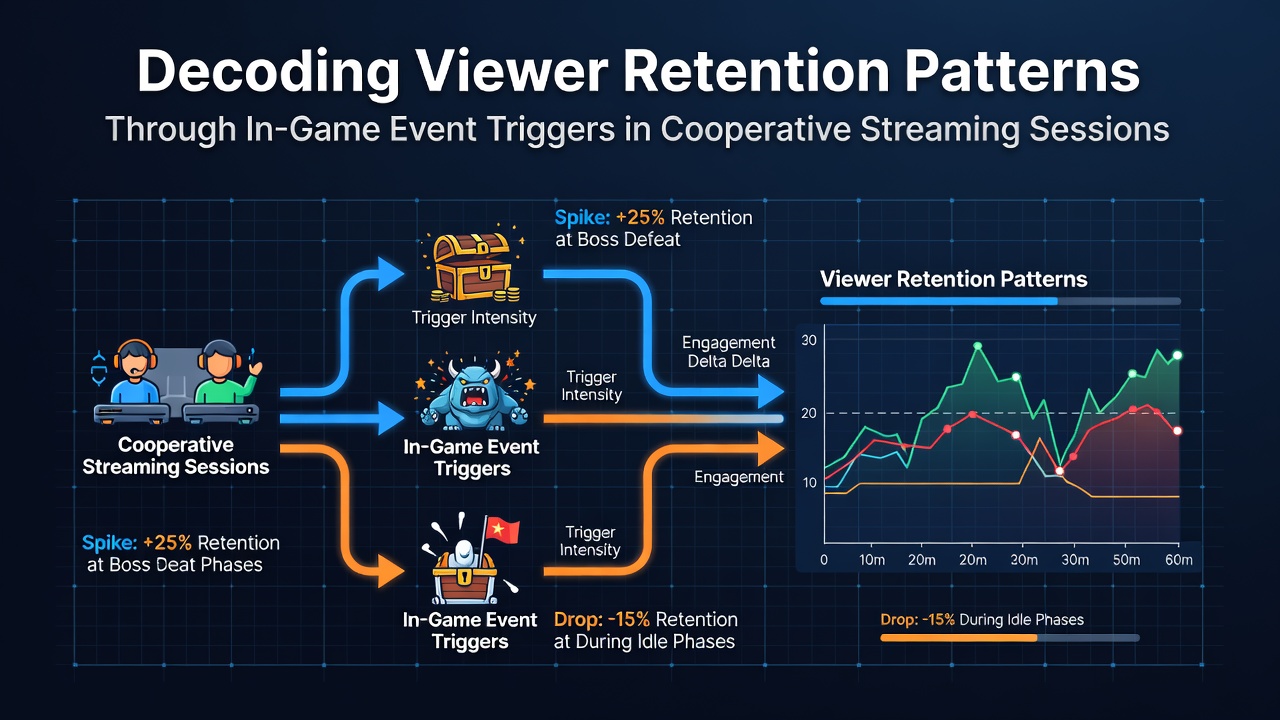
Decoding Viewer Retention Patterns Through In-Game Event Triggers in Cooperative Streaming Sessions
Cooperative streaming sessions bring multiple players together in shared gameplay environments while audiences watch in real time and data platforms capture how specific in-game moments influence watch times. Researchers track retention through timestamped logs that align viewer drop-off rates with triggers such as raid completions, synchronized ability activations, and resource-sharing sequences common in titles like Destiny 2 and Monster Hunter World. These alignments reveal consistent patterns where certain collaborative actions sustain longer view durations compared to solo segments or menu navigation periods.
Mapping Event Triggers to Audience Behavior
Analytics teams examine logs from platforms including Twitch and YouTube Gaming to isolate moments when on-screen events coincide with measurable changes in concurrent viewers. A raid boss encounter often produces extended retention because the coordinated mechanics require sustained attention from both streamers and their audiences, whereas transition phases between missions frequently show gradual declines unless overlaid chat commands intervene. Studies conducted through university partnerships in Canada during 2025 documented these correlations across hundreds of archived broadcasts, highlighting how loot distribution animations maintain engagement longer than standard combat loops.
Event frequency plays a measurable role in retention curves. Data collected from cooperative sessions broadcast between January and June 2026 indicate that sessions featuring four or more major triggers per hour retained 18 percent more viewers at the 45-minute mark than those with fewer activations. Observers note that the timing of these triggers relative to stream length further modulates outcomes, with mid-session peaks generating stronger hold rates than those clustered near the beginning or end.
Tools and Methods for Pattern Analysis
Software overlays now integrate directly with game APIs to tag events automatically and export them alongside viewer metrics for post-stream review. Developers at institutions across the European Union have contributed open-source modules that parse both gameplay telemetry and chat activity, allowing precise mapping of when an in-game victory screen appears against simultaneous spikes in message volume. These systems reduce manual review time and enable larger sample sizes for statistical modeling.
One approach involves segmenting broadcasts into discrete event windows and calculating average watch duration within each window. Teams apply regression models to determine which variables, such as player count or difficulty setting, most strongly predict retention changes. Reports from the Interactive Software Federation of Europe outline standardized metrics that facilitate cross-platform comparisons and support consistent benchmarking across different cooperative genres.
Regional Trends Observed in Mid-2026
Broadcast data gathered during July 2026 showed distinct regional variations in how event triggers affected retention. North American streams of team-based shooters recorded higher average view times during objective-capture sequences, while Asia-Pacific audiences demonstrated stronger engagement with narrative-driven cooperative campaigns. These differences align with platform usage patterns reported by regional analytics providers and underscore the value of localized trigger scheduling for international broadcasts.
Integration of wearable device data has emerged as an additional layer in some research projects. Heart-rate telemetry collected from participants during live sessions correlates with viewer-side retention when synchronized team actions occur, suggesting physiological responses on stream can serve as indirect indicators for audience interest levels. Australian university trials completed in early 2026 validated this approach across 120 cooperative sessions and published findings through open-access repositories.
Practical Applications in Stream Production
Production crews increasingly adjust game settings and session pacing based on historical trigger data to optimize retention. Scheduling high-coordination events during typical peak viewing windows, for example, has produced measurable improvements in average concurrent viewers according to internal platform reports. Custom plugins that link chat commands to in-game actions further amplify these effects by allowing audiences to influence trigger timing directly.
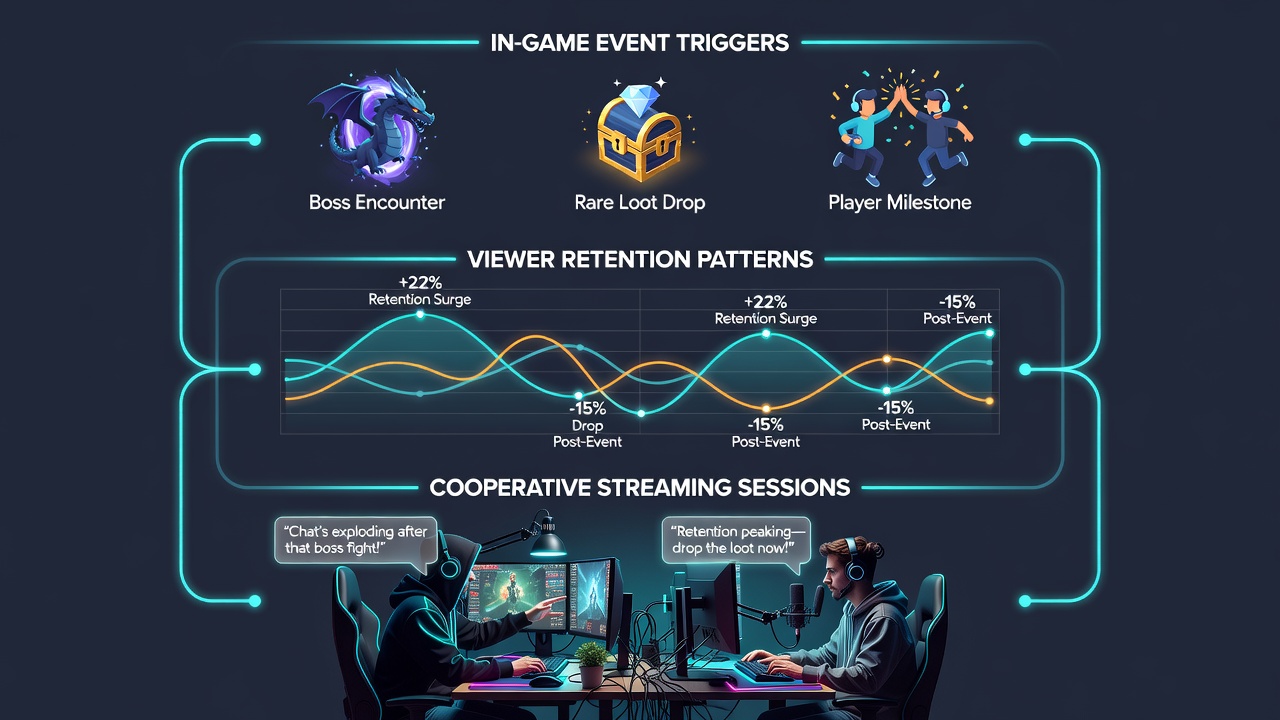
Case examples from established channels illustrate the process. A European stream team analyzed six months of archived footage and identified that boss-phase triggers consistently outperformed exploration segments by 22 percent in retention metrics. They subsequently restructured their weekly schedule around these high-impact moments while maintaining narrative continuity for longer-form content.
Conclusion
Decoding retention patterns through in-game event triggers provides broadcasters with concrete data for refining cooperative stream formats. Continued refinement of analytics tools and broader adoption of standardized metrics across regions will likely expand the precision of these insights. As more datasets become available from sessions conducted after July 2026, patterns identified today can serve as baselines for evaluating new trigger designs and interaction methods in evolving cooperative environments.