Machine Learning Approaches for Extracting Viewer-Retaining Moments from Archived Multiplayer Game Replays
Carlo Long · Aug 6, 2026
Machine Learning Approaches for Extracting Viewer-Retaining Moments from Archived Multiplayer Game Replays
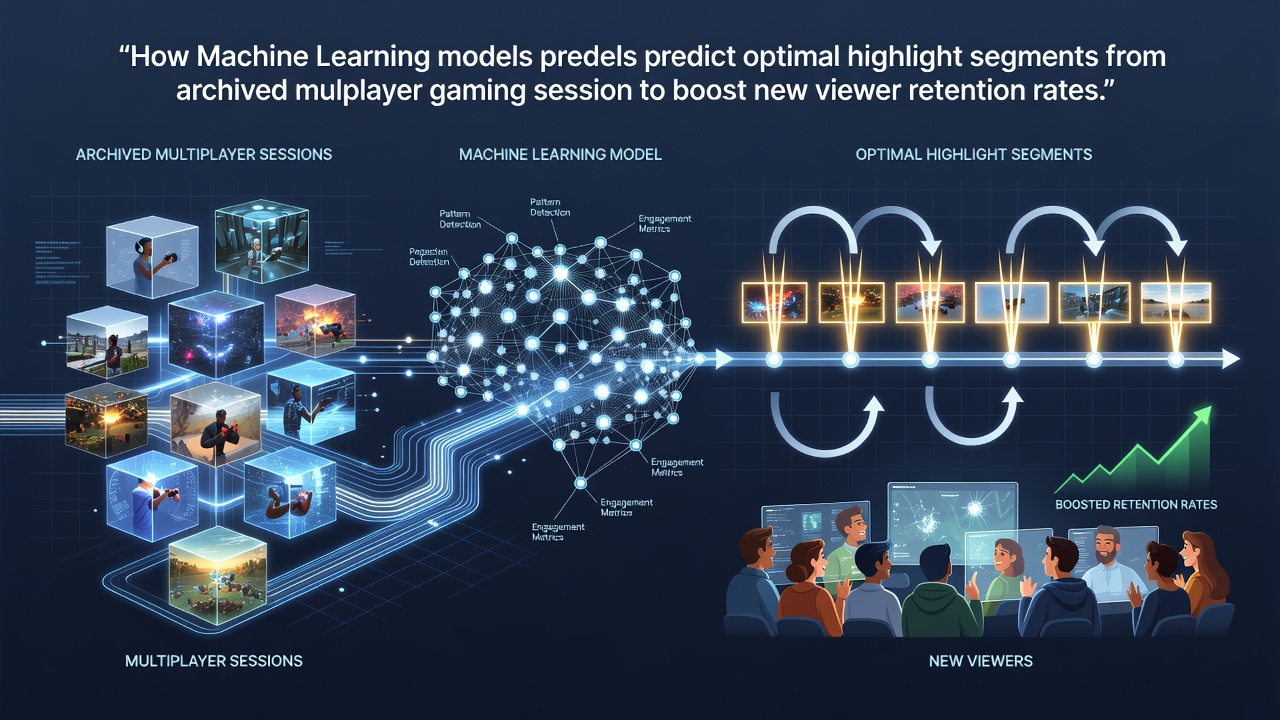
Archived multiplayer sessions contain vast amounts of raw footage that machine learning models process to locate segments likely to hold new viewers attention and raise retention rates. Researchers train these systems on datasets that combine gameplay telemetry with historical viewer behavior metrics, and the models learn to score moments based on patterns such as rapid kill sequences, strategic comebacks, and coordinated team maneuvers. Data from platforms that store millions of hours of esports matches shows that automated highlight detection now operates on recordings collected through August 2026, allowing content creators to surface clips without manual review of entire archives.
Core Data Inputs and Feature Engineering
Models ingest structured logs that record player positions, health values, ability activations, and objective captures at sub-second intervals, while additional layers incorporate chat volume spikes, concurrent viewer counts, and average watch duration per segment. Engineers normalize these inputs across different game titles so that a model trained on one competitive shooter can transfer knowledge to another title with similar mechanics. Feature sets often include derived variables such as momentum shifts calculated from consecutive objective changes and excitement scores derived from deviation from average game pace, and these engineered features improve prediction accuracy when models classify segments as high-retention candidates.
Model Architectures in Use
Supervised classifiers including gradient-boosted trees and recurrent neural networks process sequential data to predict whether a given window of play will retain viewers beyond the first thirty seconds of a clip. Reinforcement learning variants treat highlight selection as a sequential decision problem where the reward signal comes from observed completion rates on previously recommended segments. Hybrid architectures combine convolutional layers that analyze visual frames with transformer blocks that model long-range dependencies across match timelines, and studies from institutions in multiple regions indicate these combined approaches reduce false positive rates on low-interest moments while surfacing clips that align with documented viewer drop-off patterns.
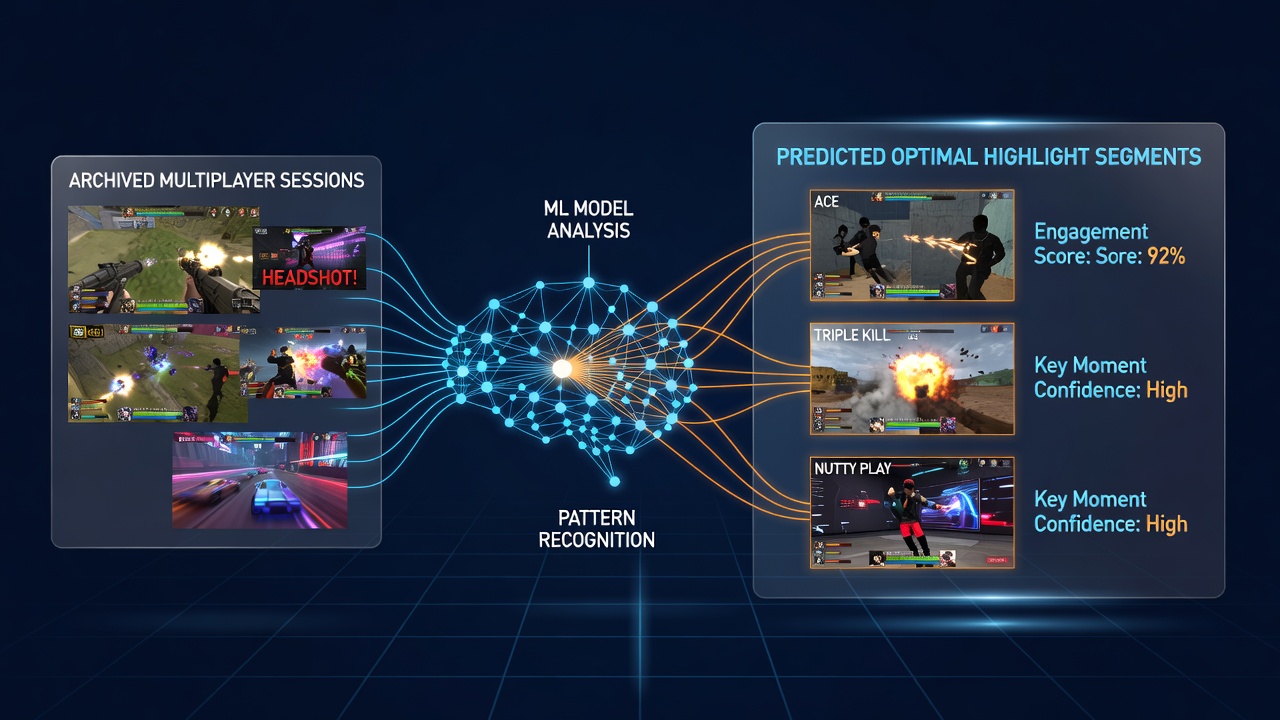
Training pipelines update weights periodically using fresh retention data collected from platform analytics dashboards, and transfer learning techniques allow models to adapt quickly when new game patches alter core mechanics. Observers note that ensembles of models frequently outperform single architectures because they balance precision on action-heavy segments with recall on narrative-driven moments such as clutch plays that unfold over longer durations.
Integration with Content Distribution Systems
Once models assign retention scores, automated pipelines push the highest-ranked segments into recommendation carousels and social media clips that appear on viewer feeds within minutes of archive ingestion. Platforms link these outputs to metadata tags that describe game mode, map location, and participating teams, and this tagging enables targeted distribution to audiences that previously watched similar content. Reports from industry groups such as the Entertainment Software Association document how these automated workflows have increased the volume of discoverable clips while maintaining consistent quality thresholds across large libraries.
Evaluation Metrics and Retention Impact
Teams measure success through metrics that track average view duration on surfaced clips, return visit rates within seven days, and the percentage of new accounts that reach a second viewing session. Controlled deployments compare retention curves for algorithmically selected highlights against randomly sampled segments from the same matches, and results consistently show higher completion rates for model-predicted clips. Academic work published through university repositories in Europe and North America further indicates that combining highlight prediction with personalized thumbnail generation produces additional lifts in click-through rates for first-time viewers.
Challenges in Cross-Game Generalization
Models encounter difficulties when gameplay conventions differ substantially between titles, because visual cues and event frequencies vary enough to degrade transfer performance. Researchers address this by maintaining separate fine-tuned branches for major game franchises while sharing lower-level feature extractors that capture universal signals such as sudden acceleration in action density. Ongoing work explores federated learning setups that let multiple platforms contribute gradient updates without exposing raw session data, and early trials reported in 2026 demonstrate improved robustness across regional server populations.
Conclusion
Machine learning pipelines now routinely convert archived multiplayer sessions into libraries of retention-focused highlights by combining telemetry analysis, behavioral modeling, and iterative performance tracking. These systems operate at scale across platforms that serve global audiences, and continued refinement of feature sets along with architectural improvements supports broader application as new titles and viewer cohorts emerge.